

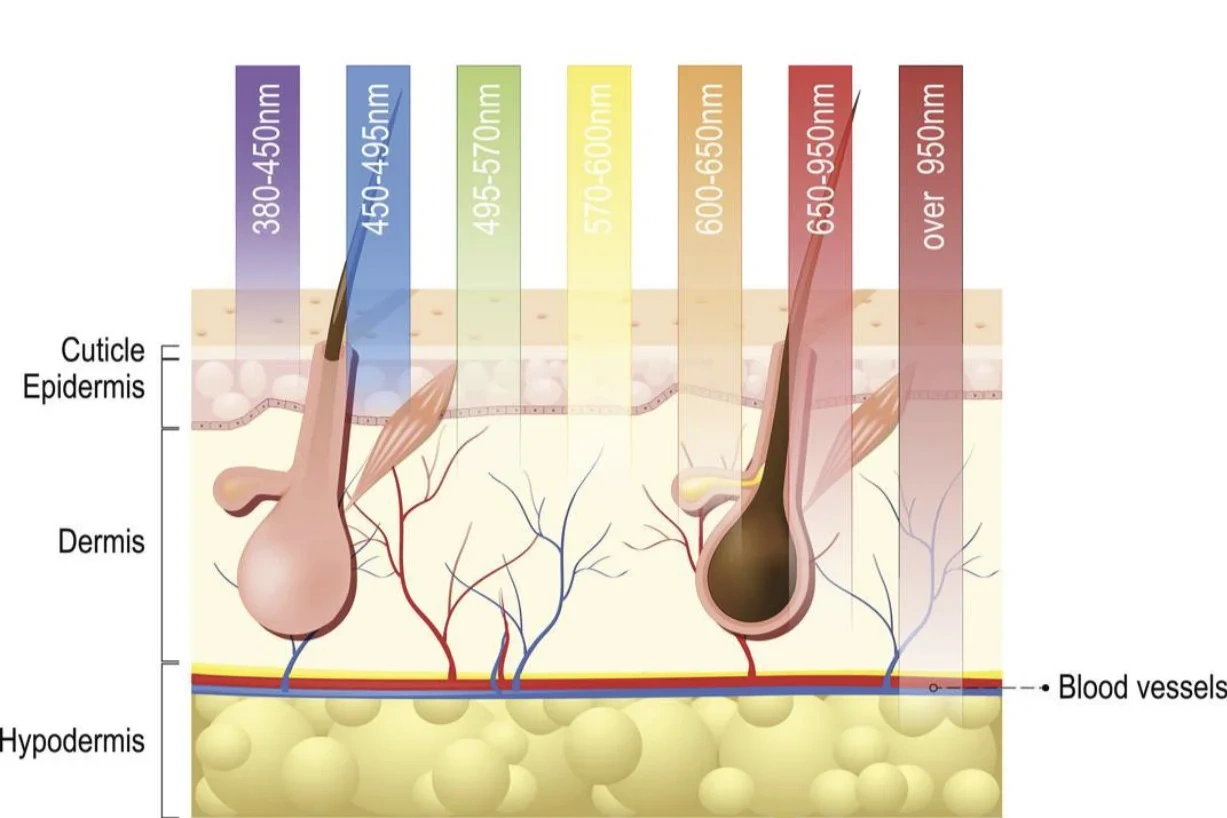
At Dry Eye Equation, we use an advanced LLLT system from Optometric Aesthetics that allows us to deliver multiple wavelengths of light at the same time, with precise control over the intensity of each wavelength.
Rather than cycling through colors, we deliver red, blue, yellow, and infrared light simultaneously.
Imagine rows of red, blue, yellow, and infrared LED bulbs placed side-by-side, repeated across the treatment panel. Each wavelength is present at the same time, and we independently adjust the intensity of each color based on your specific condition.
This flexibility allows us to tailor treatment more precisely and treat multiple contributors to dry eye in a single session— especially for complex or chronic dry eye cases.
LLLT is often used as a supportive or maintenance therapy and is frequently combined with IPL, Tixel, or gland expression treatments for optimal results.
LLLT works at the cellular level to:
No — and this is an important distinction.
In-office LLLT devices deliver significantly higher and more therapeutic energy levels than at-home LED masks. Consumer devices are intentionally designed to be low-power for safety and general wellness. Our system delivers medical-grade, calibrated energy capable of producing measurable biological effects.
At-home devices may feel similar, but they do not deliver the same intensity, consistency, or depth of effect.
No. LLLT works through photobiomodulation, not heat or tissue injury. Even at higher therapeutic intensities, the goal is to stimulate cellular activity — not to burn or damage tissue. Treatments remain comfortable and safe when delivered appropriately.
LLLT is typically performed as a series or 2 per week for 3 weeks, followed by maintenance as needed. The number and frequency depend on:
LLLT complements other therapies by:
It is often part of a layered, comprehensive dry eye strategy.
By doing LLLT immediately following Tixel 2, the post procedure inflammation is nearly eliminated.
LLLT may be especially helpful if you have:
A Dry Eye Evaluation allows us to determine whether LLLT should be part of your personalized plan.



710 Military Cutoff Rd Suite 130, Wilmington, NC 28405
(910) 447-2020 | info@dryeyeequaton.com
Follow us on:
Crafted with Love: DigiCorns